
How Transaction Accelerators Prioritise Packing
An accelerator does not outbid anyone in the mempool — it changes who gets to choose. Normal blocks are filled by fee rate, highest first, and a transaction that paid too little simply loses that auction. An accelerator instead hands a transaction ID to a pool that builds its own blocks, so the transaction can be placed in the next template the pool assembles. The free tier is limited to transactions of 0.5 KB or smaller paying at least 0.0001 BTC/KB, which is 0.00005 BTC — about $4.23 at $84,692.

Key takeaways
- Ordinary block construction ranks transactions by fee rate; an accelerator substitutes a manual scheduling decision for that ranking, which is why it can rescue a payment nobody would otherwise pick up.
- The free tier has hard edges: at most 0.5 KB and at least 0.0001 BTC/KB, an allowance that refreshes hourly and is processed in submission order.
- Price the shortcut against your own output. The 0.00005 BTC floor is about 26.7 hours of gross earnings for a 100 TH/s rig and roughly 2.7 hours for a 1 PH/s setup.
- Paid acceleration is settled from the account balance in BTC, BCH or LTC, and a submitted transaction cannot be cancelled or refunded — so check eligibility before you submit, not after.
Definitions first
Mempool. The pool of valid transactions that nodes have seen but that are not yet in a block. It is not a queue with a front and a back; it is a market, and the clearing price is whatever the next block has room for.
Fee rate. Fee divided by transaction size, not fee divided by value transferred. A large payment paying a modest absolute fee can rank lower than a tiny payment paying more per byte. Accelerator documentation states its threshold in the same units — 0.0001 BTC/KB — alongside a size cap of 0.5 KB, which together define who qualifies for the free queue.[1]
Block template and packing. A miner assembles a candidate block by selecting transactions from its mempool view, ordering them so the block stays within weight limits. Packing is the selection and ordering step. Standard software sorts by fee rate; an operator can also instruct the software to include a specific transaction, which is precisely what a submitted acceleration request is.
Priority packing. The result of that instruction: the submitted transaction is queued for inclusion in the next block the pool mines, ahead of transactions that only compete on fee rate.
The trade-off nobody prices
Every bump has two costs, and most discussions only mention one. The visible cost is the fee or the paid acceleration charge. The invisible cost is the time the value stays unusable — a payment that has not confirmed cannot settle an invoice, and an exchange deposit that has not confirmed does not show up in a balance.
There is also a distributional detail worth knowing before you judge the price. The fee you pay to be included does not disappear into the block subsidy; it becomes the transaction-fee component of the block. On ViaBTC's PPS+ method, the per-share block reward carries a listed 4% fee while the transaction-fee component follows PPLNS logic under a listed 2% fee; under PPLNS both are distributed together behind a single listed 2%.[2] If you are a miner, some of what you pay for priority may come back to you as part of the same pool's fee revenue — a circularity that fee tables never show.
| Rig size | Gross output per day | Free-tier frame in USD | Equivalent hours of output |
|---|---|---|---|
| 100 TH/s | 0.0000449 BTC ≈ $3.80 | ≈ $4.23 | ≈ 26.7 hours |
| 500 TH/s | 0.0002243 BTC ≈ $19.00 | ≈ $4.23 | ≈ 5.4 hours |
| 1 PH/s | 0.000449 BTC ≈ $37.99 | ≈ $4.23 | ≈ 2.7 hours |
| 2 PH/s | 0.000897 BTC ≈ $75.99 | ≈ $4.23 | ≈ 1.3 hours |
Example with two setups
Setup A is a single 100 TH/s machine. Its gross output is $3.80 a day, $3.65 after the listed fee on the block-reward component. Rescuing one 0.5 KB transaction at the free-tier floor costs about $4.23 in bandwidth terms — more than a day of that machine's production. For this operator the rational move is usually patience: wait an hour, see whether the mempool clears, and only pay when the payment is genuinely time-critical.
Setup B is a 1 PH/s operation. The same transaction costs the same $4.23, which is roughly 2.7 hours of output, and the pool's own settlement clock makes that easy to fund: PPS+ pays hourly against current difficulty, so this operation receives about 0.0000187 BTC — roughly $1.58 — every hour.
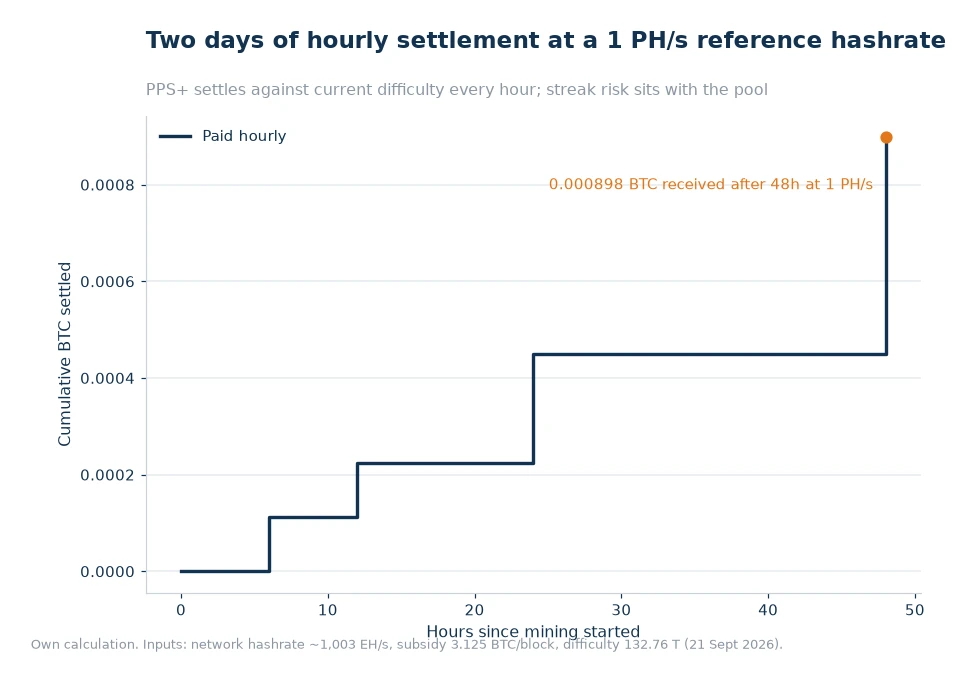
Notice what the chart implies for scheduling. Two days at 1 PH/s settles about 0.000898 BTC, and every hour on the step adds another slice. An operation at that size can treat a small bump fee as a line item funded by income already in flight, rather than as a capital decision. The same reasoning does not transfer to a single machine, where the fee is a meaningful fraction of the day — which is the whole point of running the arithmetic per rig instead of copying a policy from a forum post.
When you do decide to pay, keep the mechanics simple. The submission form at the ViaBTC TX Accelerator takes a transaction ID; the free queue is processed in submission order and refreshes its allowance hourly, and the paid path draws BTC, BCH or LTC straight from the account balance so no separate wallet is involved in the rescue.
Practical next steps
- Measure the transaction before you submit it. Size decides whether the free tier is even available to you.
- Check the fee rate in the documented units. The free tier threshold is expressed per kilobyte, not per transaction.
- Confirm every input is already confirmed. A transaction spending an unconfirmed output cannot be accelerated; accelerate the parent first.
- Do not submit twice. The free allowance refreshes hourly and submissions are handled in order, so duplicates add nothing.
- Keep a funded balance if the payment matters. The paid route settles from the account immediately, in BTC, BCH or LTC, which is faster than moving coins in from elsewhere.
- Track it on the payout side. Everything about your mining revenue, including settled payouts and any accelerator charges, is visible from the account's mining pool dashboard alongside a multi-currency wallet that holds the balances the fee is drawn from.
Frequently asked questions
How often should a miner check pool statistics?
Weekly is enough for cash flow, daily if you are reconciling worker uptime or chasing a hashrate fault.
Does the payout method change my average income?
It changes the variance and the fee, not the underlying expected value: your share of network hashrate still sets the ceiling.
Does submitting a transaction mean it will confirm in the next block?
No. A submitted transaction is queued for priority packing in the next block the pool mines; which block that turns out to be depends on the network, not on the submission.
Do the arithmetic once per rig
Write down your daily gross output, then divide the bump cost by it. If the answer is a handful of hours, the accelerator is a scheduling tool you can use casually. If the answer is more than a day, patience is the cheaper strategy and the free queue is worth a try before anything else. Recheck both numbers whenever difficulty moves materially, because the fee floor is fixed while your output is not.
Data and sources: ViaBTC transaction accelerator documentation[1] and ViaBTC pricing page[2]; network difficulty and hashrate read from public chain data with BTC at $84,692 on 21 September 2026. Figures are illustrative and change with difficulty and price — read on 21 September 2026.